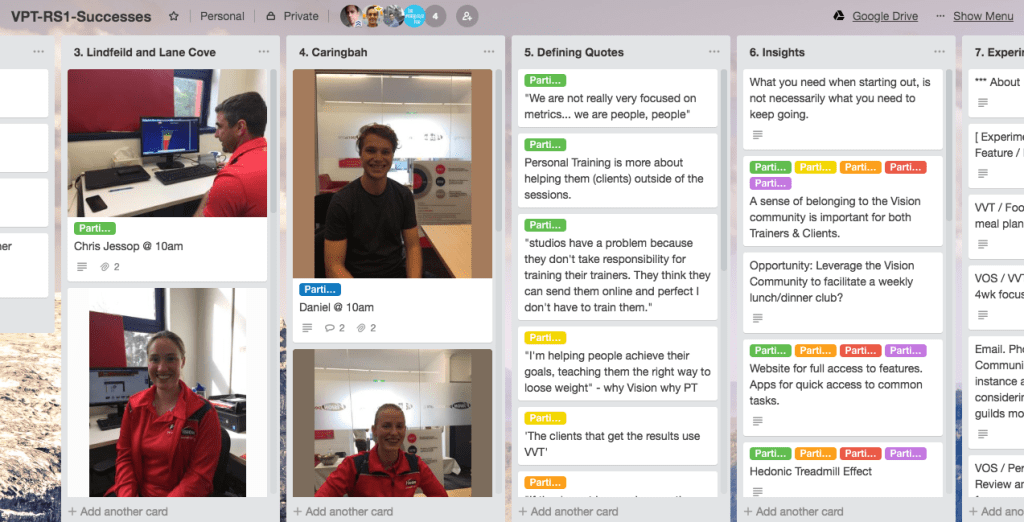
Project: Design research to understand the users and usage of their various digital products.
Background: VisionPT is a personal training business that aims to help with Australia’s obesity problem. Specifically, its programs target middle-aged women and men wanting to lose some weight, but their approach helps clients get results, regardless of their current situation.
After a rapid rise to 50 franchises, business growth has plateaued. The digital ecosystem has been accumulated in pieces over time. A combination of system bugs being reported, poor feature usage via analytics, and negative anecdotes from staff have indicated that a holistic review is required before growth is invested in.
Technical Context: The digital ecosystem is based on a bespoke technical architecture that’s maintained by a small internal team, however there are several external partners that are engaged to maintain the corporate website, develop and update mobile apps, and provide an intranet service.
Design Context: There are no in-house Researchers or Designers, so design decisions impacting users have been made around business requests and technical architecture. Many of the digital tools seem to have been digitised from paper-based predecessors. Whilst the organisation was keen to uncover insights from user research, their appetite was more focused on minor usability improvements, rather than understanding users’ needs.
Design Team: Facilitated by consultancy The Privileged Few, Phil Banks and I helped form a remote Design Research team to cover the in-house gap, with skills covering Product Management, User Research, Product Design and Service Design.
Ways of working: Research was organised into a series of sprints and was conducted on-site at VisionPT’s studios across Greater Sydney. Planning, analysis and presentations were performed remotely, with a heavy reliance on Slack, Trello, and G-Suite to collaborate. Several in-person workshops were also conducted to capture business insights and align stakeholders. Additional telephone interviews were conducted at studios in Melbourne and New Zealand.
Objective
We were engaged on this project to better understand users’ needs across three existing digital products: Staff Intranet, Client App, Website. These products are maintained by external providers.
-
It was considered important to ensure these products were optimised before expanding the franchise network.
-
Significant manual effort is required to train new franchises and new staff to use the digital ecosystem effectively. Additionally, after time, Clients & Staff reduce their usage of the tools, leading to a reduction in data available for the business.
-
With poor data quality being captured it is making it difficult to understand the operational effectiveness as the network grows.
Work
Predicting the future is difficult, full of uncertainty, and new information is always being discovered. Teams often focus on the delivery of something, instead of its business impact. To help combat these factors, our approach followed a version of The Double Diamond design process model which breaks the work into the following four phases:
-
Discover
-
Define
-
Design
-
Develop
Discovery was broken into 3x 4-day Research Sprints. Each sprint was self-contained and focused on learning about studios with different characteristics:
-
Successes – Studios in Sydney where they have great performance results in areas like Client Retention.
-
Challenges – Studios in Sydney where they’re challenged by things like higher than average staff turnover.
-
Outliers – Studios & Clients out of Sydney (NZ & Melbourne) and Owners with more than one franchise.
Each sprint’s structure was identical:
Day 1: Prepare
-
Planning workshop to explore and decide on learning goals
-
Participants finalised from a previously established shortlist
-
In terview Guides drafted (one per user type), including any required task-based testing
Days 2 & 3: Conduct
-
8-10 Contextual Inquiries conducted in the studios
-
Initial analysis performed between interviews
-
Notes & recordings are logged at the end of the day
Day 4: Analyse
-
Defining quotes extracted for each participant
-
Affinity mapping performed to understand themes
-
Insights generated using abductive logic
-
Experiments proposed to test and explore the insights
-
A lightweight presentation showcases the research
-
A retrospective allows for improvements to be made next sprint
In addition to the Contextual Inquiries, other research techniques were also employed to triangulate user attitudes and behaviours. These included: Mystery Shopping, Heuristic Reviews, Proto-Personas, and Journey Mapping.
A subsequent “Define” phase focused on aggregating the research, analysing the data, summarising insights and presenting the findings at a franchise owners conference. A vision and plan were also proposed.
The Design & Develop phases are yet to be commenced. The plan is to form a cross-functional team which will conduct a series of experiments against the vision towards digital transformation. By exploring and validating options, we find the best ways to succeed. Finally, as we gain confidence in the solution, exploration gives way to engineering, and we create and optimise working software.
End result
As a result of the work, the proposal creates a path to improving the use of the digital ecosystem. The key insight was “Time is service (more than money). Simplifying tasks with technology means happier staff and leaves more capacity to serve clients.”
Project Outputs
We also reframed the approach for ongoing budgeting of innovation, as well as operational and capital expenditure.
Future metrics for success could include:
-
Improve Staff effectiveness; reduce user error; increase productivity; increase user satisfaction; increase job satisfaction; increase ease of use; increase ease of learning; increase trust in systems; decrease support costs; reduce training costs
In addition, this increased use could lead to the following business outcomes:
-
Saving money: Reduce staff retention costs; save development costs; save development time; reduce maintenance costs; reduce bugs and feature requests; save redesign costs
-
Making money: Increase usage leading to retained clients; increase loyalty; attract more customers; increase market share; more franchise scalability
Reflection
VisionPT is an important business. Their goal is to help middle-aged women and men combat Australia’s growing obesity problem. However, some of the things that provided early success are the same things that are holding them back now. The current digital ecosystem has been built in pieces, each trying to use technology improve the business. But nothing has been designed holistically around the end user’s tasks. VisionPT isn’t a startup anymore to get to the next level, it needs to act at the next level.
The results of the Discover & Define phases helped to frame a digital transformation strategy for the organisation. However the client’s appetite and budget to transform are not currently in place. In an attempt to clarify the importance of moving forward in this manner and how to budget for it, a lot of additional consulting time was invested. Ideally this scope would’ve been agreed before commencing the project so that the transition from Define into Design was more seamless.

 Sam Court